
Planning a trip to Seoul can make it tempting to choose treatments from a menu before you have a consultation. But a treatment name, package price, or social media photograph cannot tell you whether a procedure is appropriate for you.
I’m Dr. Yuro Kang, a physician practicing aesthetic medicine in Seoul. This guide focuses on consultations for nonsurgical treatments, including skin-tightening procedures, injectables, and laser treatments. Surgery requires a separate discussion of surgical risks and travel planning.
Use these seven questions to turn a treatment menu into a conversation about your needs.

1.
Who will assess me,
and who will perform the treatment?
Ask for the treating clinician’s name, qualifications, and experience with the specific procedure you are considering.
A clinic’s online identity does not tell you who will be responsible for your care. Ask whether you will meet the treating doctor before deciding, and who will answer medical questions if an interpreter or coordinator helps with your visit.
For filler injections, the FDA advises choosing a licensed healthcare professional with appropriate training and experience. It also recommends discussing the risks of the particular injection site. FDA guidance
Ask: “Can I discuss the treatment plan with the doctor who will treat me, in a language I understand?”
2.
What are we treating,
and why is this the right option for me?
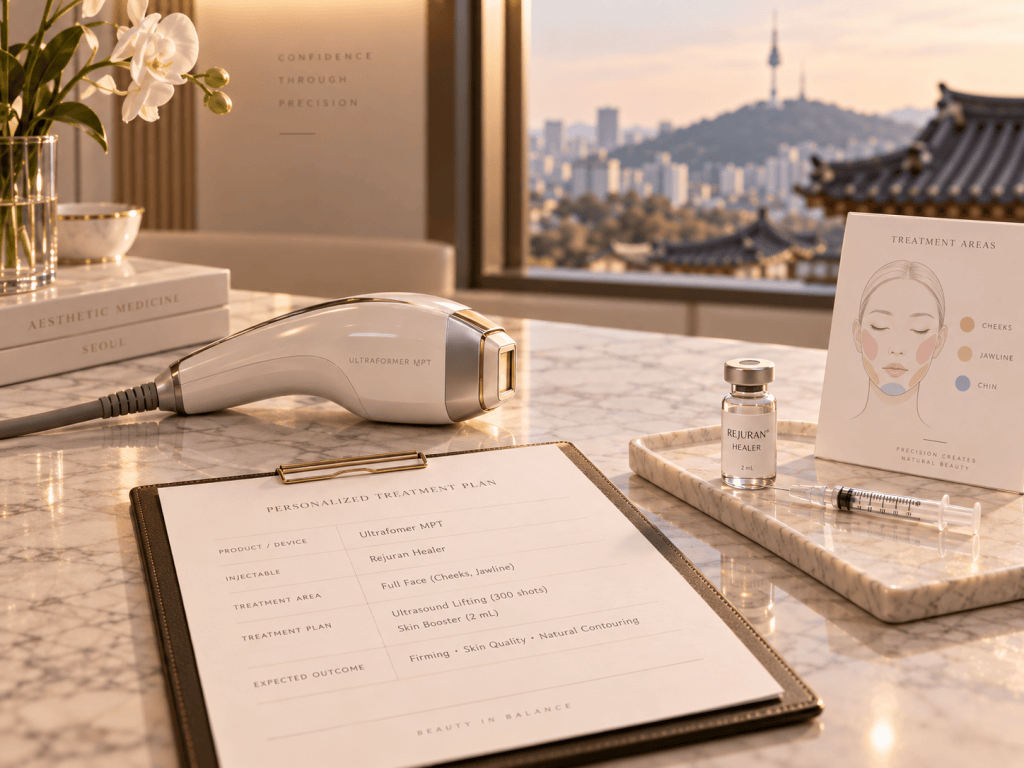
Start with the concern you want to address, then ask the doctor to explain the proposed treatment and alternatives.
Instead of starting with “Which lifting package should I buy?”, try explaining what you notice, when it bothers you, and what kind of change you would consider worthwhile.
Bring a list of medications, allergies, medical conditions, and previous procedures, including the products and dates if available. Ask which details affect the recommendation. Do not stop prescribed medication on your own to prepare for a cosmetic appointment.
A useful consultation should leave room for a different procedure, postponement, or no treatment.
Ask: “What makes me a suitable candidate, and what would make you advise against this treatment?”
3.
Which exact product or device
will you use?
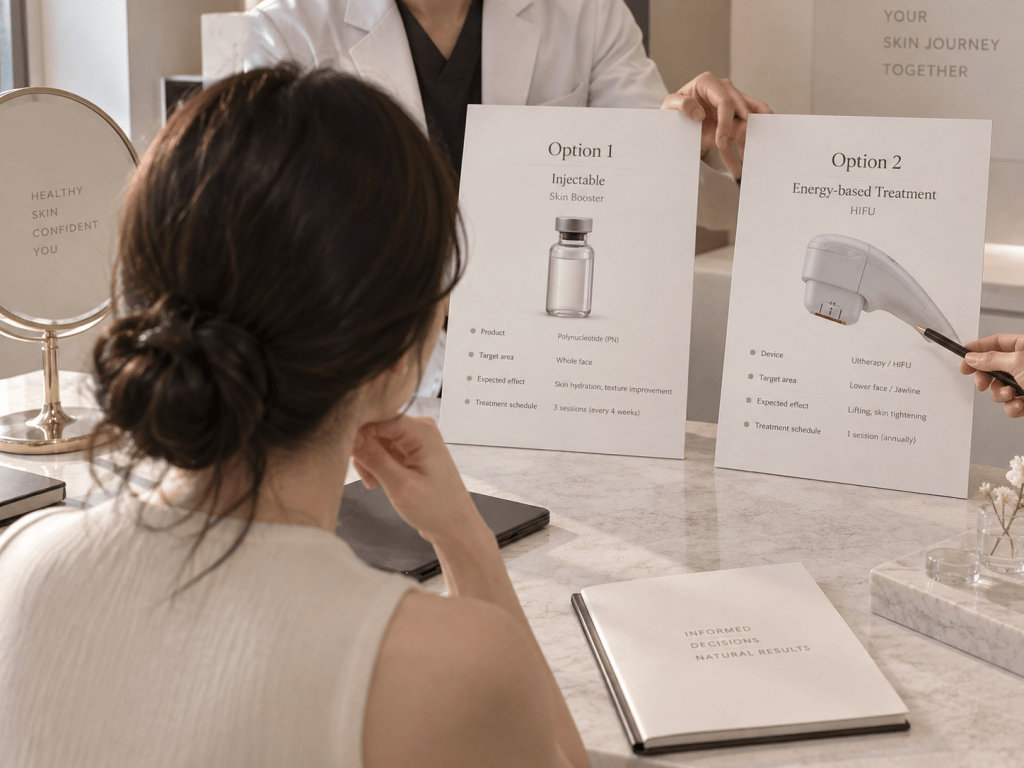
Request the product name or device model, the intended treatment area, and a written description of the proposed treatment.
Terms such as “lifting,” “skin booster,” and “laser facial” are not a complete description of what you will receive. Ask the clinic to translate the procedure into specifics:
- For an injectable: the product name, material, planned amount, and treatment area.
- For an energy-based treatment: the device model, treatment area, and reason for the proposed protocol.
- For a package: what each component is intended to achieve and whether every component is necessary.
If approval or clearance is mentioned, ask which regulator, product, and intended use the claim refers to. U.S. FDA information cited here is safety guidance; it does not establish a product’s authorization or indications in Korea.
Ask: “Can you write down exactly what will be used and why you selected it?”
4.
What improvement is realistic,
and when should we assess it?
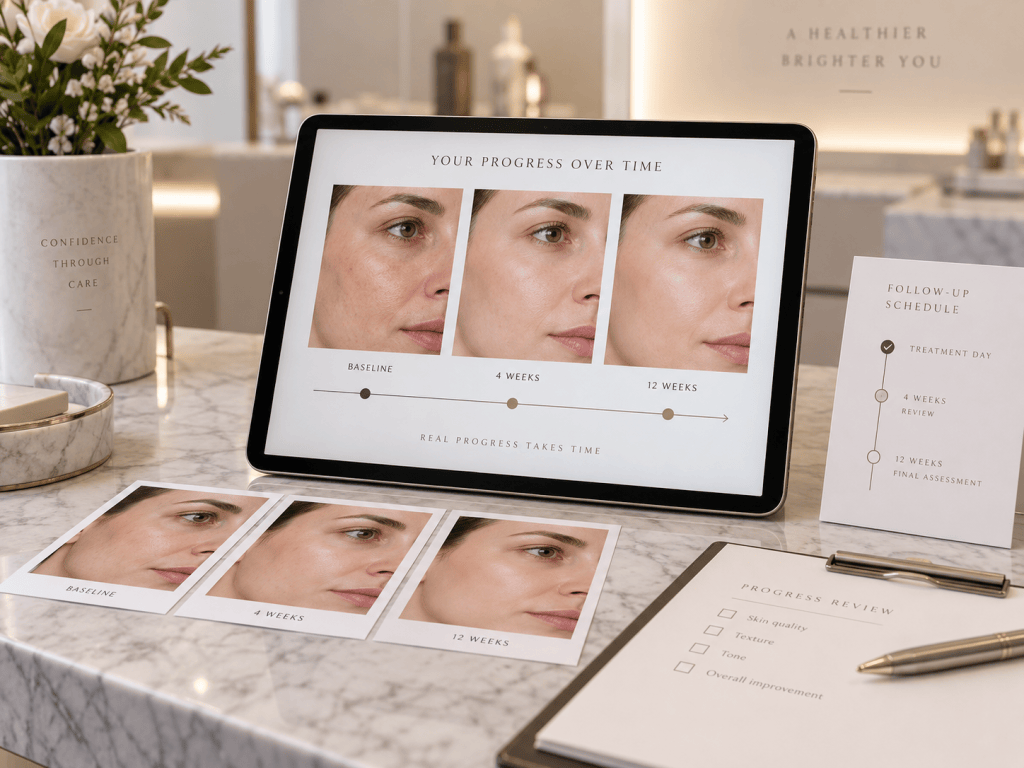
Ask about the likely degree of improvement, the assessment timeline, and what the treatment is unlikely to change.
Evidence for one technology should not be treated as a promise for every device sold under a similar label. A 2023 systematic review of microfocused ultrasound included 16 studies, all involving female patients. It found evidence of improvement in mild-to-moderate facial skin laxity, but protocols varied and the authors called for better objective outcome assessment. This does not establish that all ultrasound devices give equivalent results. Contini et al., 2023
When looking at before-and-after photographs, ask when they were taken and whether lighting, expression, and camera angle were comparable. Ask whether the result shown is typical for someone with your concern.
Ask: “When should we judge the result, and what would count as a meaningful improvement for me?”
5.
What are the risks,
and what happens if something goes wrong?
Ask about expected reactions, serious complications, and the clinic’s response plan.
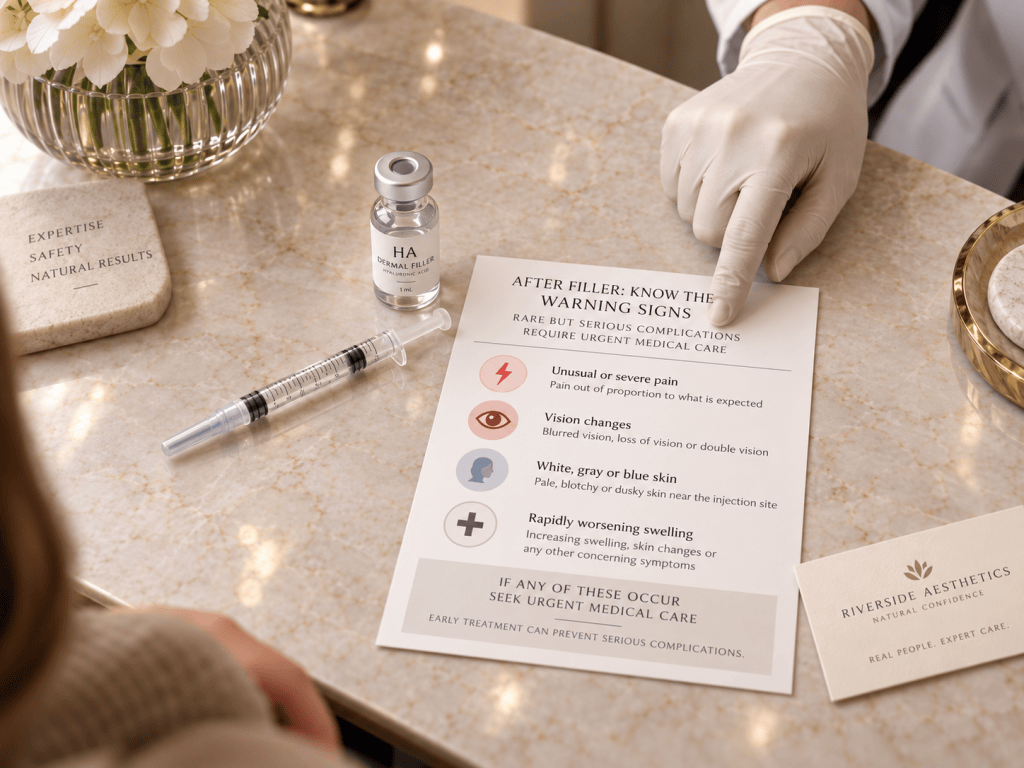
The risk discussion should be specific to the treatment. For example, fillers can cause bruising and swelling; accidental injection into a blood vessel can cause tissue injury and, rarely, blindness or stroke. These risks should be discussed before consent. FDA guidance
A clinical guideline on hyaluronic acid filler-related vascular occlusion emphasizes recognition and timely management. It supports asking about emergency preparedness, rather than assuming a complication cannot happen. Murray et al., 2021
After filler injection, unusual pain, changes in vision, or white, gray, or blue skin near the injection site require immediate medical attention. Do not wait for a routine online reply. FDA guidance
Ask: “Which symptoms require urgent care, and who should I contact outside opening hours?”
6.
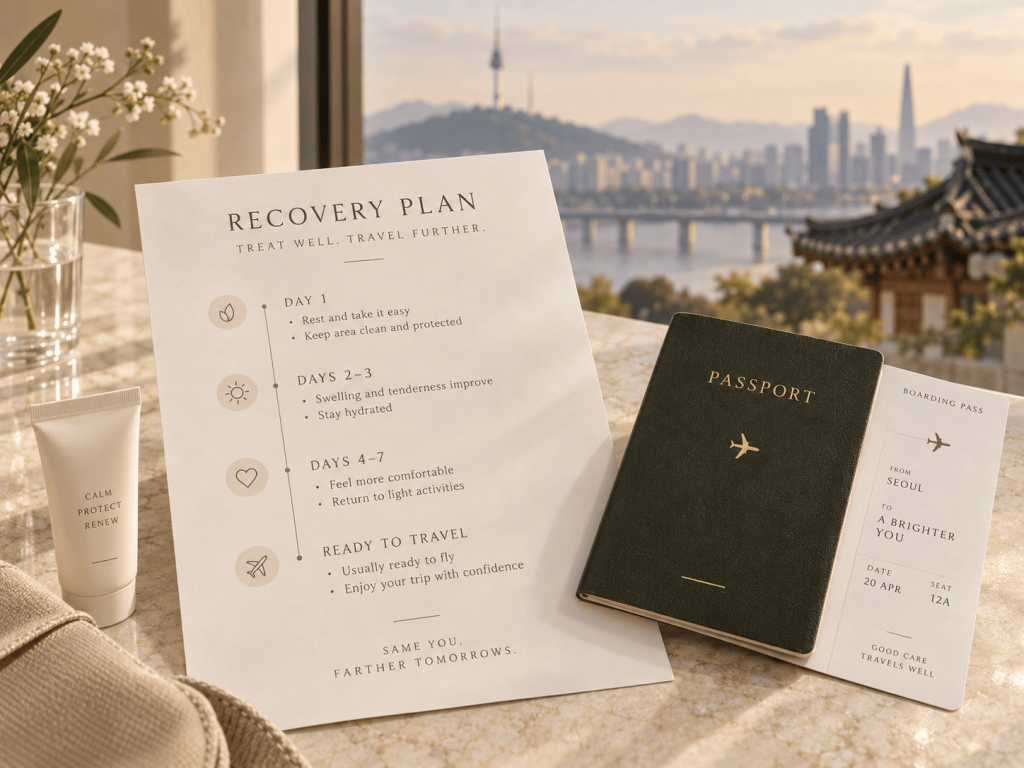
How does recovery fit my travel schedule?
Give the doctor your departure date and ask for a recovery and review plan tailored to the actual procedure.
Do not assume that a treatment advertised as having little downtime is automatically appropriate immediately before your flight. Ask when you can resume your planned activities and whether an in-person review is needed before leaving Korea.
CDC guidance highlights the importance of recovery planning and warns that vacation activities can interfere with postoperative healing. Its surgical travel advice should not be converted into a single waiting period for every nonsurgical treatment. CDC Yellow Book
Ask: “Given my flight and itinerary, should we change the treatment or postpone it?”

7.
What is included in the cost,
and who will follow up after I leave?
Request an itemized quote and a written aftercare plan before committing.
Clarify consultation fees, the treatment itself, any anesthesia or medication, planned review visits, and charges for additional care. Ask how follow-up works across time zones and what happens if you need an examination after returning home.
CDC recommends understanding follow-up costs and obtaining medical records for continuity of care. Ask for an English treatment summary, including the date, treated areas, and products or devices used. CDC Yellow Book
Ask: “What records and contact details will I receive, and who can assess me if a problem develops at home?”
A short checklist to save
before your appointment
Before agreeing to treatment, make sure you can explain:
- Who is responsible for your care.
- Why the treatment fits your concern.
- What product or device will be used.
- What improvement is realistic.
- Which risks and symptoms need attention.
- How recovery fits your trip.
- What you will pay and how follow-up works.
If an answer is unclear, ask again before deciding. You do not need to commit to a procedure simply because you have already booked a consultation or traveled to Korea.
My guiding principle is simple: understand the treatment before making the decision.
Learn more about Dr. Yuro Kang and the approach behind this blog.
* This article provides general educational information and does not replace an individual medical assessment.
References
1. U.S. Food and Drug Administration. Dermal Fillers (Soft Tissue Fillers). Official patient and clinician safety information. U.S. regulatory guidance; not a statement of Korean approval status.
2. Centers for Disease Control and Prevention. Medical Tourism. CDC Yellow Book. Page dated April 23, 2025. General travel and continuity-of-care guidance; not a Korean nonsurgical complication-rate study.
3. Contini M, Hollander MHJ, Vissink A, Schepers RH, Jansma J, Schortinghuis J. A Systematic Review of the Efficacy of Microfocused Ultrasound for Facial Skin Tightening. Int J Environ Res Public Health. 2023;20(2):1522. doi:10.3390/ijerph20021522. PubMed. 4. Murray G, Convery C, Walker L, Davies E. Guideline for the Management of Hyaluronic Acid Filler-induced Vascular Occlusion. J Clin Aesthet Dermatol. 2021;14(5):E61–E69. PubMed. Full text.
 Dr. Yuro
Leave a comment